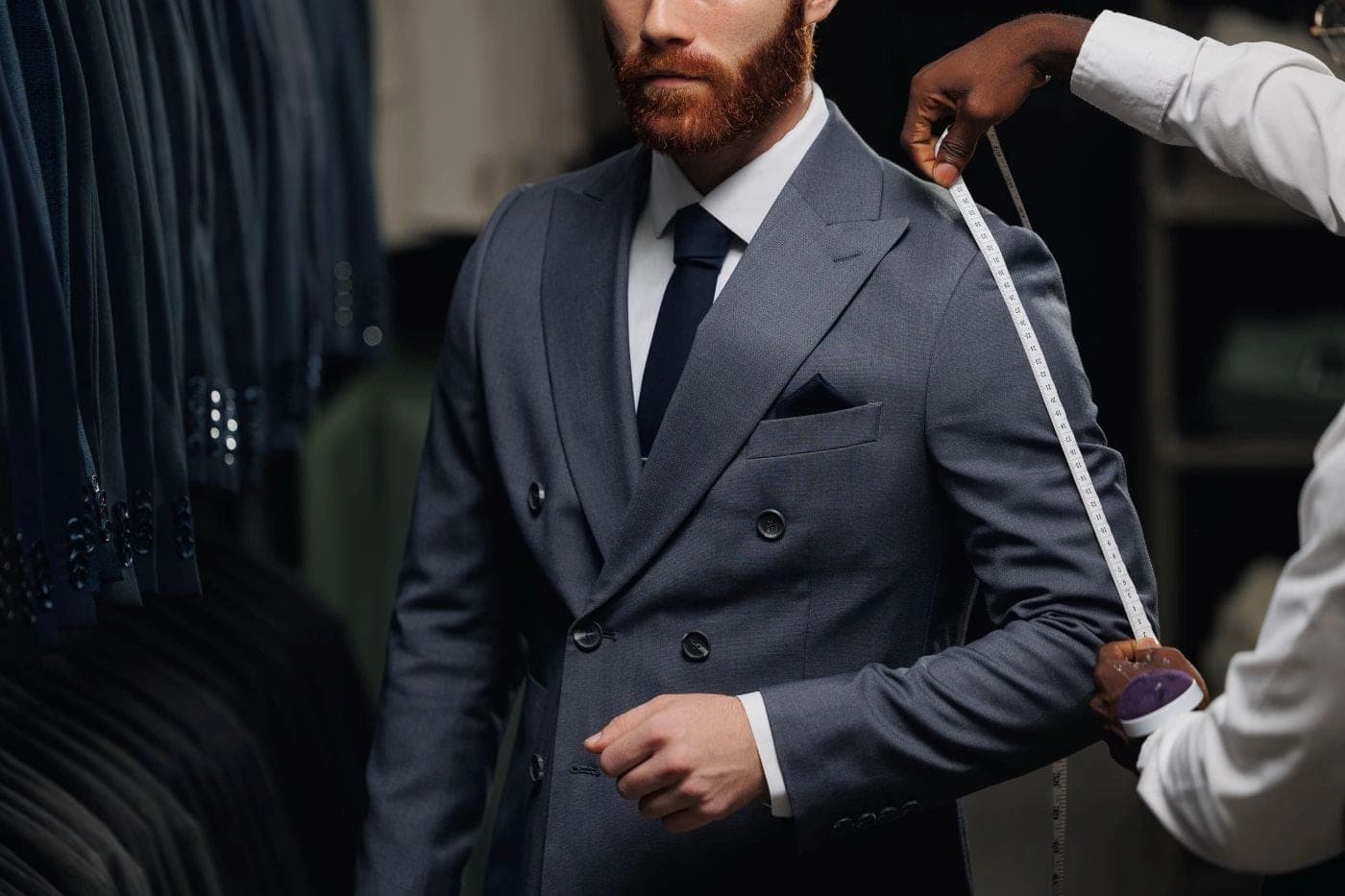



Someone searches "tailored suit cost" late on a Sunday night, usually with a wedding, a promotion, or a wardrobe that no longer fits the life it belongs to. Sometimes it is a groom comparing quotes six months out. Sometimes it is someone who has just been asked to stand up in front of a room and realized the suit in the closet was bought for a different job entirely.
This post is for that person, whoever they are and whatever brought them here. A tailored suit at Conxeppt starts at $1,188, and this piece explains what that figure actually pays for, not what it should mean in the abstract. The number on its own tells you nothing useful. What follows is meant to.
What Tailored Suit Cost Actually Means
The word tailored gets used loosely. Some retailers use it to describe a slimmer cut on a stock pattern. Merriam-Webster defines bespoke as custom-made for a particular buyer, which is closer to what happens here: a suit built from your own measurements rather than adjusted from someone else's block.
That distinction matters because it changes what you are pricing. A suit taken in at the seams is still built for another body first. A tailored suit is built for yours from the first cut of cloth. The price reflects the second process, not the first.
This is not a matter of semantics for its own sake. A shopper comparing two suits at similar prices needs to know whether one was cut against a personal pattern and the other pulled off a size run and pinned to look closer. The first process involves a draft that exists only for you. The second involves guesswork disguised as a fitting. Both get called tailored in casual conversation, and only one of them earns the word.
The Cloth Is the First Number
Cloth is the most visible cost and the easiest to compare, because it is priced by the metre before a single stitch happens. A heavier worsted wool behaves differently on the body than a lighter fresco, and both cost more than a synthetic blend that will pill within a season. You are paying for fibre that will still hold its shape after fifty wears, not just after the first fitting.
This is why a genuine custom suit rarely starts under four figures. The collection at Conxeppt is chosen with that longevity in mind, not with a price point in mind first and a cloth found to fit it after.
Labour Is the Number Nobody Sees
A machine-made suit can be assembled in under an hour once the pattern is set. A hand-finished garment, with a floating canvas and hand-worked buttonholes, takes many hours of skilled labour per suit. That labour does not show up on a hanger. It shows up two years later, when the jacket still holds its shape across the chest instead of collapsing into the lining.
Every garment at Conxeppt is handcrafted in Europe, and that craftsmanship is the largest single line in the price, larger than the cloth itself. It is also the part a photograph cannot show you, which is exactly why it gets left out of most conversations about cost.
Why the Timeline Costs Money Too
A custom suit at Conxeppt takes four to six weeks from measurement to delivery. That is not a shipping delay. It is the time required to cut, baste, canvas, press, and finish a garment by hand rather than run it through automated production.
A faster timeline usually means a shortcut somewhere in the process, whether that is fused canvas instead of a floating one, or a pattern pulled from stock rather than drafted from your own measurements. Your own measurements are taken across more than the usual seven or eight points: shoulder slope, blade width, the drop between chest and waist, even how you tend to stand when your hands are in your pockets. Skipping any of that to save two weeks does not save you anything once the jacket is on your back.
Fittings Are Not a Formality
Fittings at Conxeppt are one-on-one, by appointment, not a quick stand-in-front-of-a-mirror check. Each fitting exists to catch something specific: how the shoulder sits under load, how the trouser breaks over the shoe, whether the canvas has settled the way it should against your particular posture.
Most custom suits move through two to three fittings before delivery, spaced roughly a week apart to allow adjustments to settle rather than being rushed through in a single afternoon. The first fitting confirms the pattern against your actual body once cloth is behind it, not just tape measurements on paper. The second checks how the canvas has moved after the first round of pressing. A third, when needed, deals with anything still not lying flat: a shoulder that rolls slightly forward, a sleeve pitch that catches when you reach. None of this happens by video call or a photo sent from home.
Off the Rack Looks Cheaper Until You Count Everything
An off-the-rack suit has a lower sticker price, and for some occasions that is the right call. But the honest comparison includes the alterations most people need afterward: shoulders taken in, sleeves shortened, trousers re-hemmed, sometimes a jacket re-cut entirely to fit a torso it was never drafted for.
Add those alteration costs to the sticker price and the gap between the two paths narrows considerably, especially once you account for how much sooner a mass-produced suit tends to lose its shape. If you are weighing the two seriously, when should you choose a custom suit over off-the-rack walks through the decision without assuming one answer fits everyone.
A Mistake to Avoid When Shopping by Price
The most common mistake in this search is comparing headline numbers without asking what sits behind them. A suit advertised at $600 and one at $1,188 are not the same product with different price tags. They are usually different canvases, different cloth weights, and a different number of hours in the workroom. Comparing the two on price alone is like comparing a car by its paint colour.
The second mistake is treating the first quote as the whole cost. A cheaper suit that needs two rounds of alterations before it fits properly is not actually cheaper once those alterations are added in, and a suit that never quite fits despite the alterations was not a saving at all, just a slower way of arriving at disappointment. The honest question is not what is the lowest number available, but what that number actually includes and what it will cost to make it fit if it does not.
This is also where timelines and price intersect. A suit built to be finished in a week, at a price that undercuts everything else on the market, has to be cutting something to make that possible. It is worth asking what, specifically, before you commit to it.
What Changes the Price Up or Down
Within Conxeppt's range, price moves with cloth weight, cloth origin, and construction detail such as working cuff buttons or a fuller canvas. A tuxedo starts from $1,388 rather than $1,188 because formalwear carries its own finishing requirements, from the facing to the lapel roll. A shirt at $288 is priced on the same principle at a smaller scale.
None of these numbers move because of a sale or a season. They move because a different cloth or a different finish takes different hours and different material. The house style sets the baseline, and anything beyond it is a choice you make in the fitting room, not a markup added afterward.
What This Costs You Over Time
A well-made suit worn for a decade costs less per wear than a cheaper suit replaced every second year, though that math only works if the garment is actually built to last that long. This is where the labour and cloth arguments meet: a suit that holds its shape does not need replacing, and a suit that needs replacing was never really a saving in the first place.
It is also why a suit that starts to look tired is not always a suit that needs replacing at all. Sometimes a half-inch adjustment at the waist or a re-set shoulder is all that stands between a suit you have stopped wearing and one you reach for again. A tailor who built the garment in the first place is usually the right person to make that call, not a guess made alone in front of a mirror.
Booking the Fitting
217 five-star reviews sit behind Conxeppt's name, and you can read them in full on the client reviews page before you book anything. Dave has built the business on one-on-one appointments rather than volume, which is a slower way to run a tailoring house and, by most accounts, the only way to run one properly.
If the number you searched for is finally starting to make sense, the next step is simple. Book a private fitting and bring the questions you still have about cloth, timeline, or fit. That conversation costs nothing, and it is usually the part that clarifies the price more than any article can.