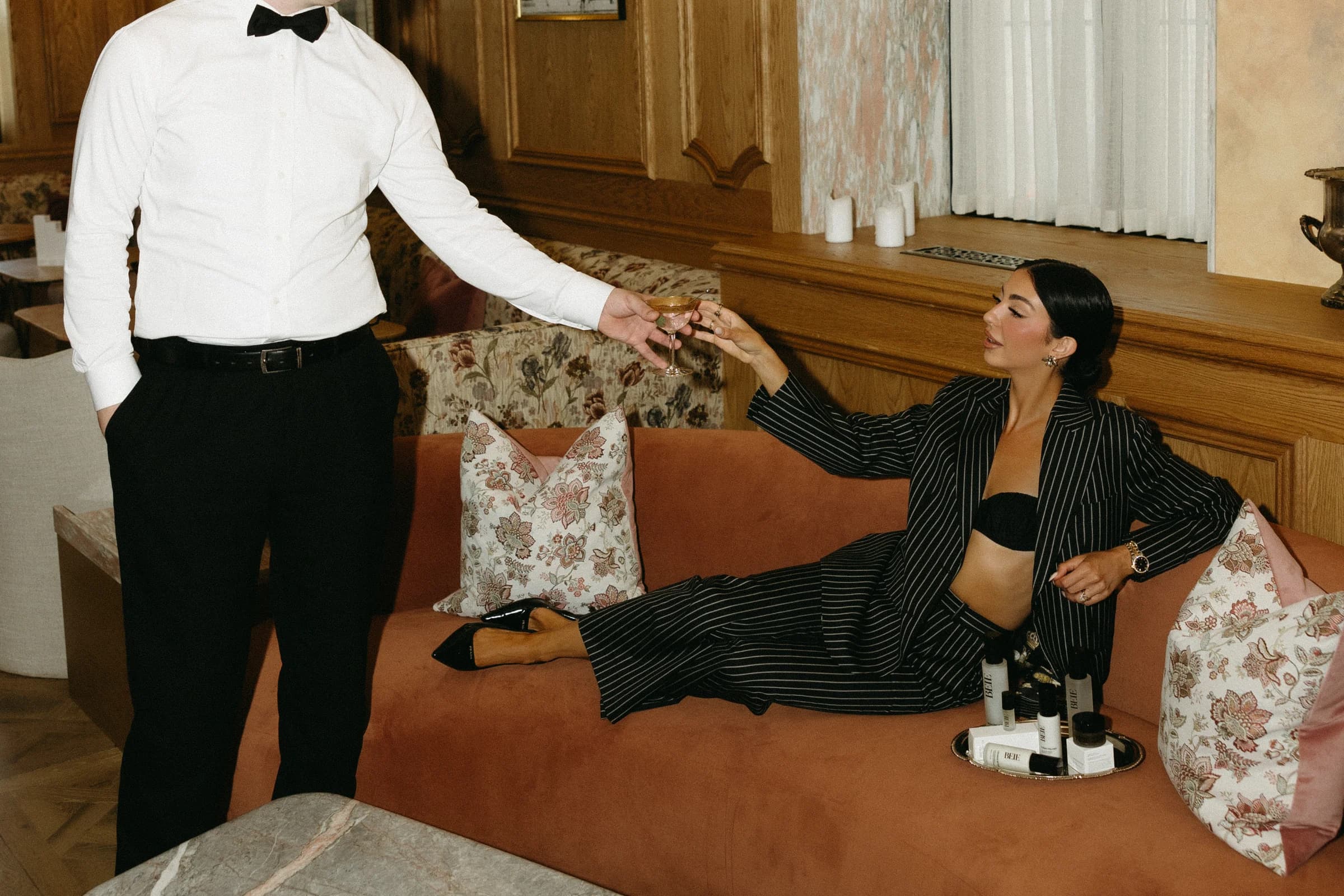

Ask a pattern cutter what separates a women's tailored suit from a men's one, and the answer starts with the body before it moves to the paper. This is the Conxeppt guide to how that difference is drafted, and to the decisions that shape a women's suit long before any cloth is cut. A men's jacket is built mostly around the chest and the shoulder. A women's jacket has to manage a bust, a defined waist and usually a fuller hip, which means more shaping over a shorter distance, with less room for error at every seam.
Why a Women's Pattern Starts Somewhere Different
That is why shrinking a men's pattern achieves so little. Scale a men's block down and you get narrower shoulders and shorter sleeves, yet the cloth still falls in a fairly straight line from chest to hem. Over a shaped figure that line either tents away from the waist or strains across the hip. Pinning the back seam tighter only moves the problem somewhere else, because the missing shape belongs in the front panels. It has to be drafted in from the first line on the paper, which is a large part of the reason women's suiting so often disappoints off the rack.
One clarification belongs early. A women's block is simply a starting geometry, and whether it suits you depends on the shape of your body. People of every build and identity wear suits cut on women's patterns, and some who shop in womenswear are better served by a straighter block with a few borrowed details. In custom work the pattern is meant to follow you, so treat the category name as shorthand for the cutter and judge the result by how it sits on you.
Darts, Princess Seams and Where the Shaping Lives
Flat cloth becomes a three-dimensional shape in two main ways. A dart is a folded wedge stitched closed, usually running up from the waist toward the bust point and down from the waist toward the hip; it removes width where the body narrows and releases it where the body is full. A princess seam does the same job by splitting the front into two curved panels that travel from the shoulder or armhole down over the bust to the hem. Both methods move cloth to the same places. They differ in how they look on the finished jacket, and in how much shaping each can carry.
Choosing between them is partly taste and partly arithmetic. Because a princess seam spreads the shaping along a long line, it handles a larger difference between bust and waist with less risk of a pointed or puckered finish. On a bold stripe or check, its long curve is harder to match, so darts are often the cleaner choice there. The larger your bust in proportion to your ribcage, the more a princess line earns its place. Cutters also make a full-bust adjustment, lengthening and widening the front over the bust before the darts are set. That extra length has to exist in the cloth before cutting, which makes it very hard to add to a ready-made jacket.
The Shoulder on a Women's Jacket
Shoulder width is set by bone. The sleeve seam should end close to the outer point of the shoulder, where the collarbone meets the top of the arm, and a jacket that runs well past it looks borrowed. Women's shoulders are often narrower than the bust or hip below them, which tempts some patterns to widen the shoulder for balance. Handled with restraint, a slightly extended shoulder with a light pad can make the hip read narrower. Pushed too far, it becomes an echo of 1980s power dressing, and the jacket starts wearing you.
Slope matters as much as width. Many women have a more sloped shoulder than a standard ready-made pattern assumes, and a jacket drafted too square collapses into a diagonal fold running from the collar toward the armpit. Consider what your shoulders carry, too. A heavy bag worn on one side every working day presses that shoulder line down and drags the jacket front sideways. Built softer, with less padding, the shoulder recovers from that daily load; a stiffly structured one tends to hold the dent. If you carry a bag that way, mention it before the pattern is drafted, since it can change how the shoulder is built.
Jacket Length and Where the Hem Falls on the Hip
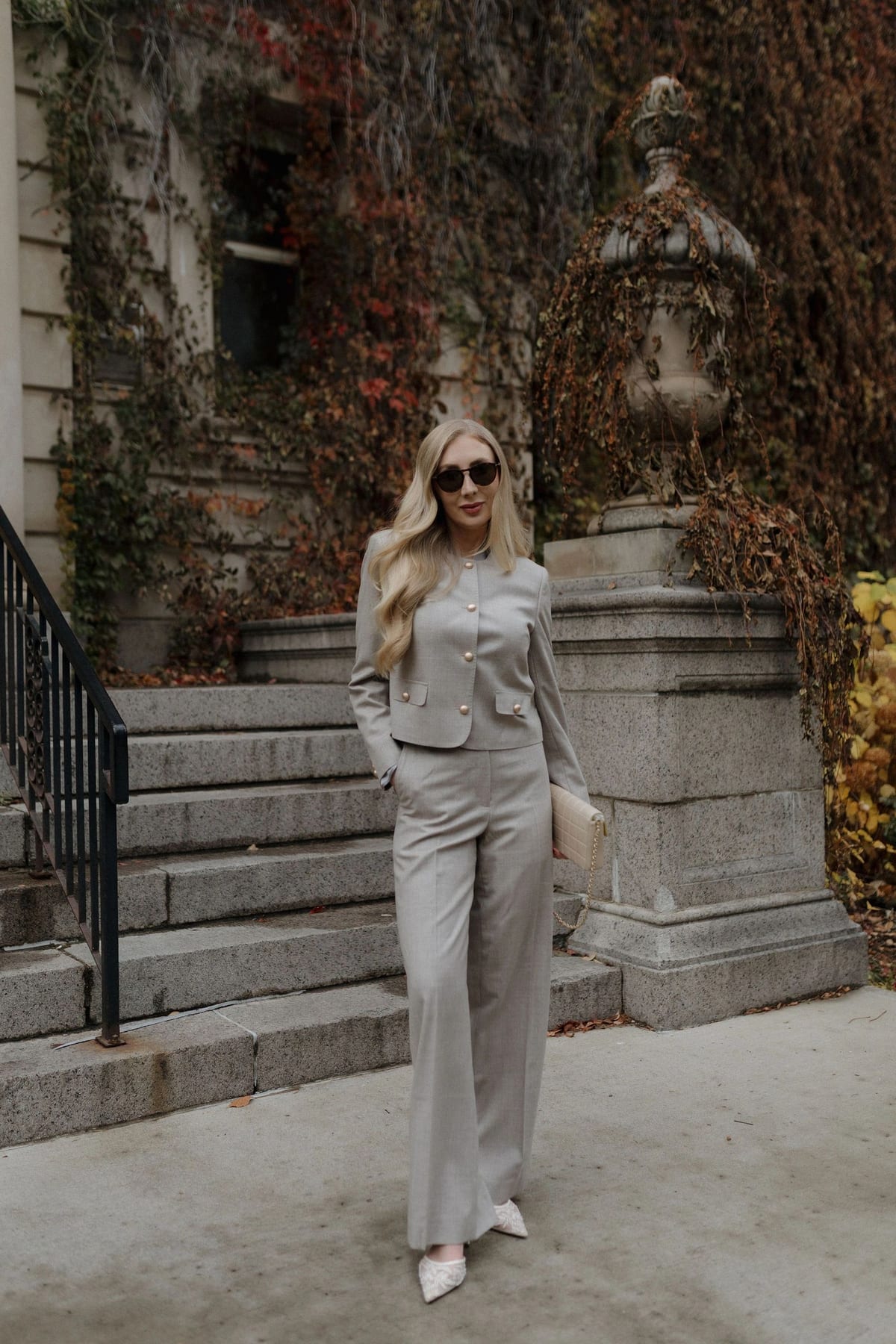
Menswear has one dominant rule for jacket length: roughly cover the seat. Women's tailoring has far more room to move, and that freedom is where proportion goes right or wrong. A cropped jacket ending near the natural waist works with high-waisted trousers or a full skirt, because it shows where the waist is. Hip length, ending around the top of the hip, is the versatile middle and sits well over almost anything. Longer jackets reaching toward mid-thigh want a slim trouser or a straight skirt beneath them; over anything wide, the whole figure starts to look boxed in.
The most common trap is a hem that lands exactly at the widest point of the hip. Stop the jacket there and you draw a horizontal line across the fullest part of the figure; the eye stops with it. Moving that hem two or three centimetres up or down usually solves the problem. It is a small measurement with a large effect, and a strong argument for having the length set on your own pattern.
Trousers and the Shoe You Hem Them For
Women's suit trousers vary far more in rise and leg than men's do. The rise is the distance from the crotch seam to the top of the waistband, and it decides where the trouser sits on you. Cut high, it sits at or above the navel and lengthens the leg; cut lower, it sits on the hip and shortens the leg visually. Leg shapes run from a narrow cigarette trouser to a full wide-leg cut that falls straight from the hip, with every width in between. Each changes how the jacket above it should be cut, so the two pieces are best designed as a pair.
Then comes the decision that spoils more trousers than any other: the shoe. A man's suit trouser is usually hemmed for one heel height, give or take a centimetre. You might wear the same suit with a flat loafer one day and a 7-centimetre heel the next, and a hem that just clears the floor in the heel will pool over the flat and wear through at the back. Wide-leg trousers are the least forgiving, because their hem is meant to sit close to the ground.
Settle the shoe before the hem is marked. If one heel height covers most of your week, bring that pair or note its height. Because every Conxeppt garment takes 4 to 6 weeks to make, buy any new shoes before the suit is started, so the hem is set for the pair you will wear. If your week splits evenly between heels and flats, a slightly cropped length or a second pair of trousers hemmed differently will serve you better than a hem that suits neither. A second pair also shares the wear, and trousers usually give out well before the jacket does.
The Skirt Suit, Cut for Walking
Skirt suits ask their own questions of the cutter. A straight or pencil skirt has to let you walk and sit, so it needs a vent or a kick pleat at the back, set at a height that allows a full stride without opening further than you would like. Length is usually judged against the knee, and the right point depends on the jacket as much as on the leg, because the two hems together divide your height into sections. An A-line skirt gives more ease and suits softer cloth. Whatever the shape, test it seated before the hem is final; a skirt that is correct standing can ride up several centimetres once you sit.
Button Side, Pockets and the Phone
By convention, women's jackets button right over left, the mirror image of menswear. Nobody agrees on why. Explanations range from ladies' maids dressing their employers to riding side-saddle, and most work better as stories than as history. What matters for you is that the side is drawn into the pattern and the buttonholes are cut through the cloth, so it is very hard to reverse afterwards. Either side is correct; the convention only matters if you want it to. If you prefer the menswear side, say so before cutting.
Pockets are the long-running complaint about women's ready-to-wear. False flaps are common, and so are pockets too shallow to hold anything heavier than a key, often to keep the line slim on a hanger. In a custom jacket you can ask for working pockets and decide how deep they go. The useful question is what you will carry in them, because every pocket you fill changes how the front hangs.
The phone is the hardest case. At more than 200 grams for a large model, a phone dropped into an outside hip pocket pulls that side of the jacket down and away from the body whenever you stand. An inside breast pocket, cut to the phone's size and placed above or beside the bust so it clears the fullest point, carries the weight closer to the body where the jacket's structure can hold it. How well the front bears that load depends heavily on construction, which our post on canvassed, fused and half-canvassed jackets explains.
Cloth That Behaves Over a Curve
Cloth has to follow shaping without fighting it, and weight decides much of how well it does. A year-round worsted of around 260 to 280 grams per metre is the usual starting point for a suit worn indoors most of the year. Lighter cloth in the 220 to 240 range drapes closer and shows every dart, which can look beautiful in a soft wide-leg trouser and unforgiving in a fitted jacket. Above 300 grams, flannels bridge small curves and skim the body, so they flatter a structured jacket but can feel stiff in a skirt that has to move.
Stretch is the other modern question. Many ready-to-wear women's suits blend a small share of elastane into the wool so that a close fit can still move. It helps in a slim trouser, but it changes the hand of the cloth and tends to hold a crease less crisply than pure wool. A pattern drafted with the right ease often makes stretch unnecessary, since the room to move is built into the cut. For how weight and texture combine across an outfit, our notes on fall layering and fabric weight go further.
Double-Breasted, Evening and Your First Women's Suit
Single-breasted jackets are the default for good reason. They close cleanly over a bust with one or two buttons and fall open easily when you sit. A double-breasted jacket overlaps two panels across the front, which adds a layer of cloth exactly where many women already have volume. It can look superb, and a lower button stance with a long lapel line keeps it from looking heavy, but it asks more of the pattern than a single-breasted cut does.
Evening tailoring for women has a well-known starting point. In 1966 Yves Saint Laurent showed Le Smoking, a tuxedo cut for women, and the idea has stayed in the vocabulary of formal dress since. A women's dinner suit follows the same logic as any tuxedo, with satin or grosgrain facings on the lapels and a matching stripe down the trouser. Whether an invitation calls for one is a separate question, and our guide to black tie, formal and semi-formal dress codes sets out the differences.
If this is your first women's suit, keep the early decisions conservative. A single-breasted, hip-length jacket over a straight trouser does more work than anything more particular, and a year-round worsted in a dark neutral will see far more days than a statement cloth. Colour deserves its own attention, and our guide to suit colours for your skin tone and hair covers it in detail. Add a skirt in the same cloth later and one suit becomes two.
Every Conxeppt garment is handcrafted in Europe and made for the person who will wear it, and custom suits start from $1,188. You can see how the house thinks about cut on the house style page. When you are ready to work through your own pattern, book a private fitting and bring the shoes you expect to wear with it.